

A garage door chain that has gone loose makes a clunky, dragging sound you cannot ignore. Left alone, it slips, jumps the sprocket, or snaps mid-cycle. The good news is that a chain or pulley problem is often a quick tension fix, as long as you know the numbers.
Let us get right to it. Most garage door chain or pulley repair comes down to tension.
Close the door, disconnect the opener, then adjust the tension nuts on the trolley. The chain should sit about half an inch above the rail at its midpoint. The trick is getting it tight enough without going too far.
The sections below walk through it all in plain words. Read on so you do it safely.
How the Chain System Works
A quick bit of background helps here. The chain runs along a metal rail and wraps around two sprockets.
One sprocket sits at the motor, the other at the end of the rail near the door. As the motor spins the sprocket, the chain pulls a part called the trolley. The trolley is what physically opens and closes your door.
The chain needs a little slack to run smoothly. Too much slack and it sags, drags, or derails. That is where most chain trouble starts.
Quick Facts
| Topic | Quick Answer |
|---|---|
| How it works | Chain wraps two sprockets and pulls the trolley to move the door |
| Top warning signs | Sagging chain, jerky door, grinding, derailment, rust, worn teeth |
| Why it loosens | Motor vibration, worn sprocket or pulley, rust, missing lubrication |
| Correct tension | About 1/2 inch above a T-rail, 1/4 inch above a square rail |
| Finger test | The chain should give about an inch when pressed |
| Do not over-tighten | A tight chain strains the motor and can snap mid-cycle |
| Keeps derailing | Worn sprocket, bent rail, or loose motor mount, call a pro |
| Lubrication | Light garage door or lithium lube, never heavy grease |
| Safe to DIY | Small tension adjustment |
| Call a pro for | Worn sprocket or pulley, snapped chain, repeat derailment |
| Fort Myers help | Same-day and 24/7 chain and opener repair, licensed since 2009 |
Signs Your Chain or Pulley Needs Repair
Your chain usually warns you before it fails. Watch for these signs.
The chain sags or hangs low below the rail. The door jerks, lurches, or stutters as it moves. You hear new grinding, slapping, or clunking sounds.
The chain has slipped off the sprocket entirely. You spot rust, worn sprocket teeth, or a loose pulley. Any one of these means it is time for a closer look.
Why a Chain Goes Loose
Chains loosen for a few common reasons. Knowing the cause helps you prevent the next one.
Constant motor vibration slowly releases the tension over time. That is the top reason by far. Worn sprocket teeth and a worn pulley let the chain slip, too.
Rust speeds it all up, which matters near the coast. Skipping lubrication does the same. A door that is out of balance strains the whole system.
How a Chain Tension Repair Works
Here is how the fix goes, step by step. Read it so you know what the job involves.
First, close the door and pull the release cord to disconnect the opener. Find the two tension nuts on the threaded bolt at the trolley. Loosen the inner nut, then tighten the outer one to take up the slack.
Set the chain about half an inch above a T-rail or a quarter inch above a square rail. A good check is to press the chain with one finger; it should give about an inch. Retighten the lock nut, reconnect the opener, then test the door.
Do Not Over-Tighten the Chain
This is the mistake people make most. A tight chain feels right, but it is not.
Over-tightening strains the motor and wears the sprockets fast. It can even snap the chain mid-cycle. The chain should be firm but still flexible, never drum-tight.
If you tighten it and the door still struggles, stop there. Something else may be wrong, like the sprocket or trolley.
When the Chain Keeps Jumping the Sprocket
Sometimes the chain keeps derailing no matter how often you adjust it. A couple of things cause this.
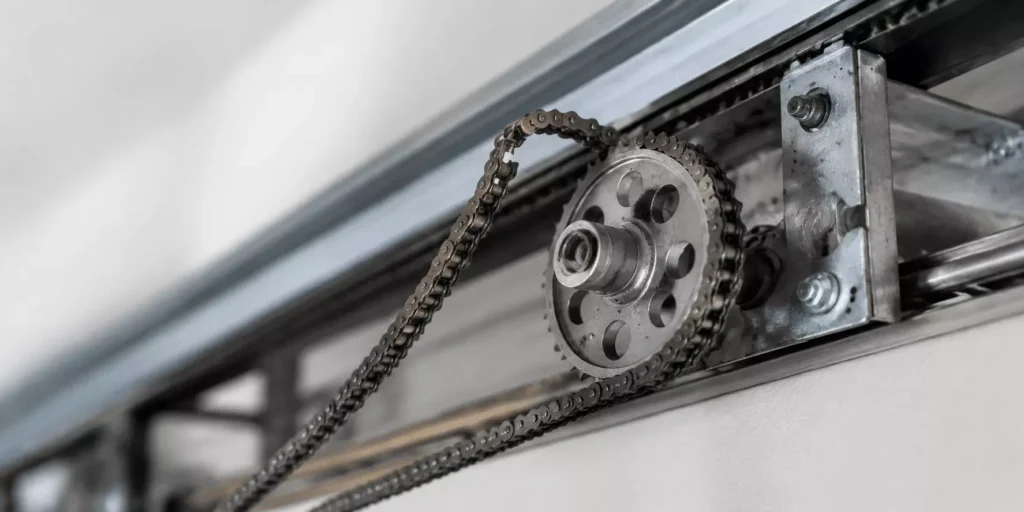
A worn sprocket with chewed teeth will not hold the chain. A bent rail or a loose motor mount creates slack on the return side. Both let the chain hang low and slip off.
These are not simple tension fixes. A worn sprocket or pulley needs replacing, which is a job for a pro.
When to Call a Fort Myers Pro
A small tension tweak is fine for a careful homeowner. A worn sprocket, a damaged pulley, a snapped chain, or repeated derailment is not.
Our team handles garage door opener repair in Fort Myers, including chains, sprockets, pulleys, and trolleys. We are Florida-licensed and insured, serving Lee County since 2009.
If a loose chain has strained the motor or the door is off balance, we check the spring and track too. Stuck after hours? Our 24/7 emergency line stays open.
Frequently Asked Questions
How tight should my garage door chain be?
It should sit about half an inch above a T-rail or a quarter inch above a square rail. Pressed with a finger, it should give about an inch.
Why does my garage door chain keep coming loose?
Constant motor vibration slowly backs off the tension. Worn sprockets and rust speed it up, so check those if it keeps loosening.
Can I tighten the chain myself?
A small tension adjustment is doable with care. Close the door, disconnect the opener, and use the trolley nuts. Call a pro for worn parts.
Why does my chain keep jumping off the sprocket?
This usually means a worn sprocket, a bent rail, or a loose motor mount. Those need repair, not just another tension tweak.
What happens if the chain is too tight?
A tight chain strains the motor, wears the sprockets, and can snap mid-cycle. Keep it firm but flexible, never drum-tight.
Should I lubricate the chain?
Yes, lightly, with a garage door or lithium-based lubricant. Skip heavy grease, since it collects dirt and gums up the system. Is a loose chain dangerous? It can be. A chain that slips or snaps can drop the door or burn out the motor, so handle it sooner rather than later.